What We Don’t Code, We Can’t Count
On air pollution, COPD, and the codes we can use right now.

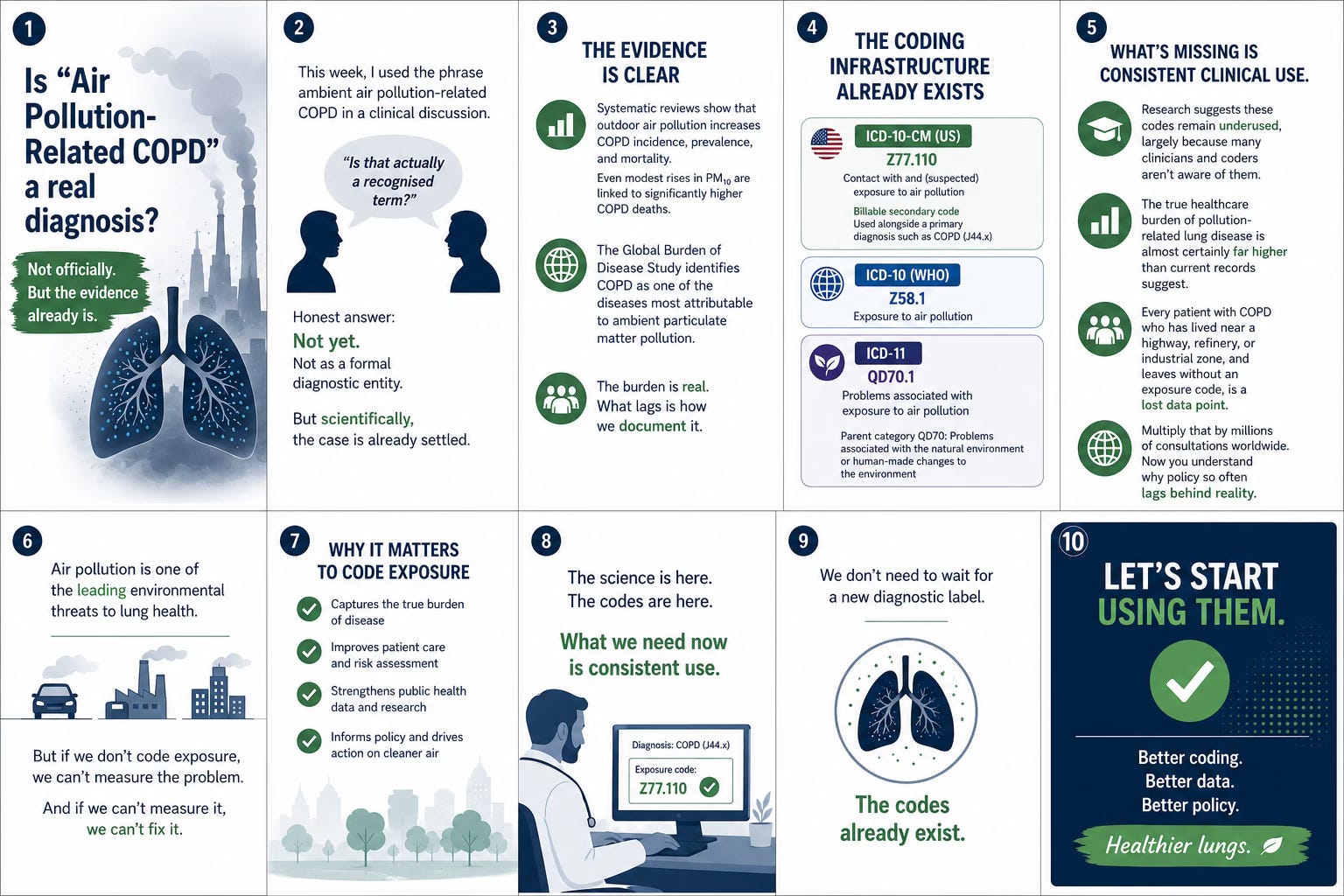
Recently, I was talking with other doctors about Chronic Obstructive Pulmonary Disease (COPD), a lung disease that makes breathing hard. I mentioned “COPD from ambient air pollution.” A colleague asked, “Is that even a real term?” I said no, not yet as an official diagnosis like “smoking-related COPD.” But just because it lacks a formal name doesn’t mean it doesn’t exist. In medicine, unnamed problems get ignored. They don’t get counted in records, so they miss out on funding, rules, and fixes. Today, let’s shine a light on this hidden issue.
Strong Proof Exists
Scientists have proven for years that breathing dirty outdoor air causes COPD. This isn’t new or shaky—it’s solid fact from big studies worldwide. The Global Burden of Disease study shows COPD as one of the top three health problems from tiny air particles called PM2.5. In 2021, PM2.5 pollution caused over 33 million years of healthy life lost to COPD globally. That’s about 41% of all COPD’s total burden.
Ozone, another part of air pollution, adds more harm. In 2021, it led to nearly 490,000 COPD deaths worldwide. Together, air pollution causes 18-23% of COPD’s global burden in lost healthy years. Most of these deaths—89%—happen in poorer countries. In 2019 alone, air pollution killed about 4.2 million people early, with COPD linked to 18% of them, or around 756,000 deaths.
We know the facts. The problem? Doctors aren’t always noting it in patient files.
Codes Are Ready to Use
Good news: We have codes to record air pollution exposure with COPD. They’ve been around since 2015. No need to invent new ones.
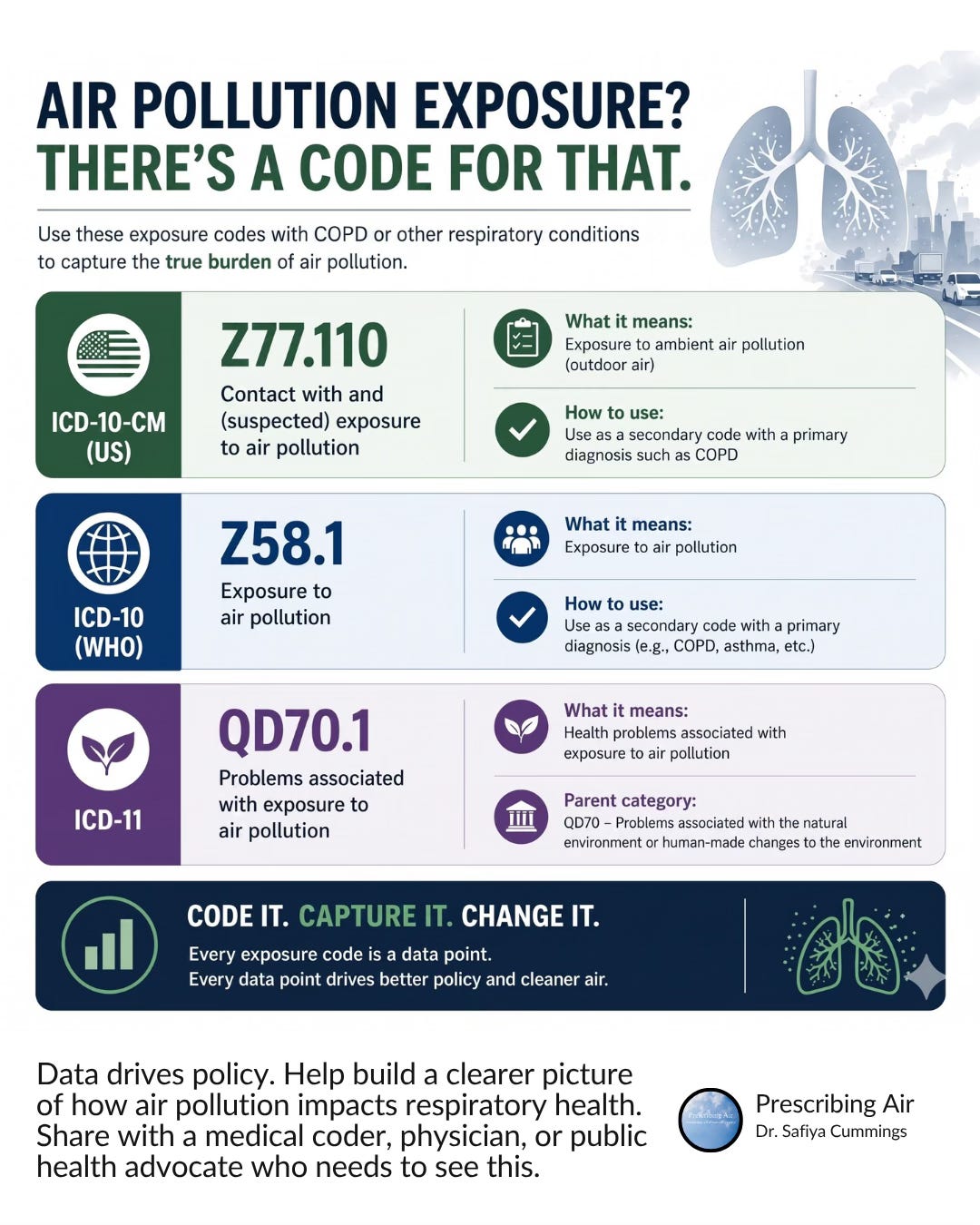
In the US, ICD-10-CM code Z77.110 means “contact with air pollution.” It’s billable but only as a second code next to COPD (J44.x). It’s valid through 2026.
Outside the US, WHO’s ICD-10 uses Z58.1 for “exposure to air pollution.”
The newest, ICD-11 (started 2022), uses QD70.1: “problems from air pollution exposure.” It’s under environmental issues, separate from smoking or noise. ICD-11 says “problems associated with” exposure, hinting at real health damage. As of 2024, 72 countries started using ICD-11, and 14 report data with it.
These codes let us track pollution’s role without free-text notes that no one counts.
Why We’re Missing the Full Picture
Even with codes, most doctors and coders don’t use them. Studies show we undercount pollution’s health toll. For COPD patients who never smoked but live near factories, busy roads, or polluted cities, we often skip the code. Each missed code hides one data point. Multiply by millions of visits, and the true size vanishes.
This hurts everyone. Governments see low numbers, so they don’t act. No tighter air rules, no extra funds for lungs. We’re letting pollution stay “invisible” in records.
The Real Cost of Hiding It
My newsletter’s goal: Make the unseen seen. Air pollution is sneaky—you can’t always smell or see it. But it fills lungs with tiny particles, scarring them like smoke does. Without codes, treatment costs rise, but causes stay hidden. Policymakers need numbers to make change.
Coded data builds proof. It turns daily doctor notes into big stats that push for “air pollution COPD” as an official term soon—maybe in 10 years.
What Doctors Can Do Now
If you treat COPD, especially in non-smokers from dirty-air spots, code the exposure. Use:
US: Z77.110 with J44.x
International ICD-10: Z58.1
ICD-11: QD70.1
Tell your team. Bring it to meetings. It’s simple but powerful. One code per patient adds up to demand action.
We can’t wait for a fancy label. Code now to count now. What isn’t coded can’t change. Let’s make air pollution’s harm visible—one record at a time.